
Reinforcements and reintroduction
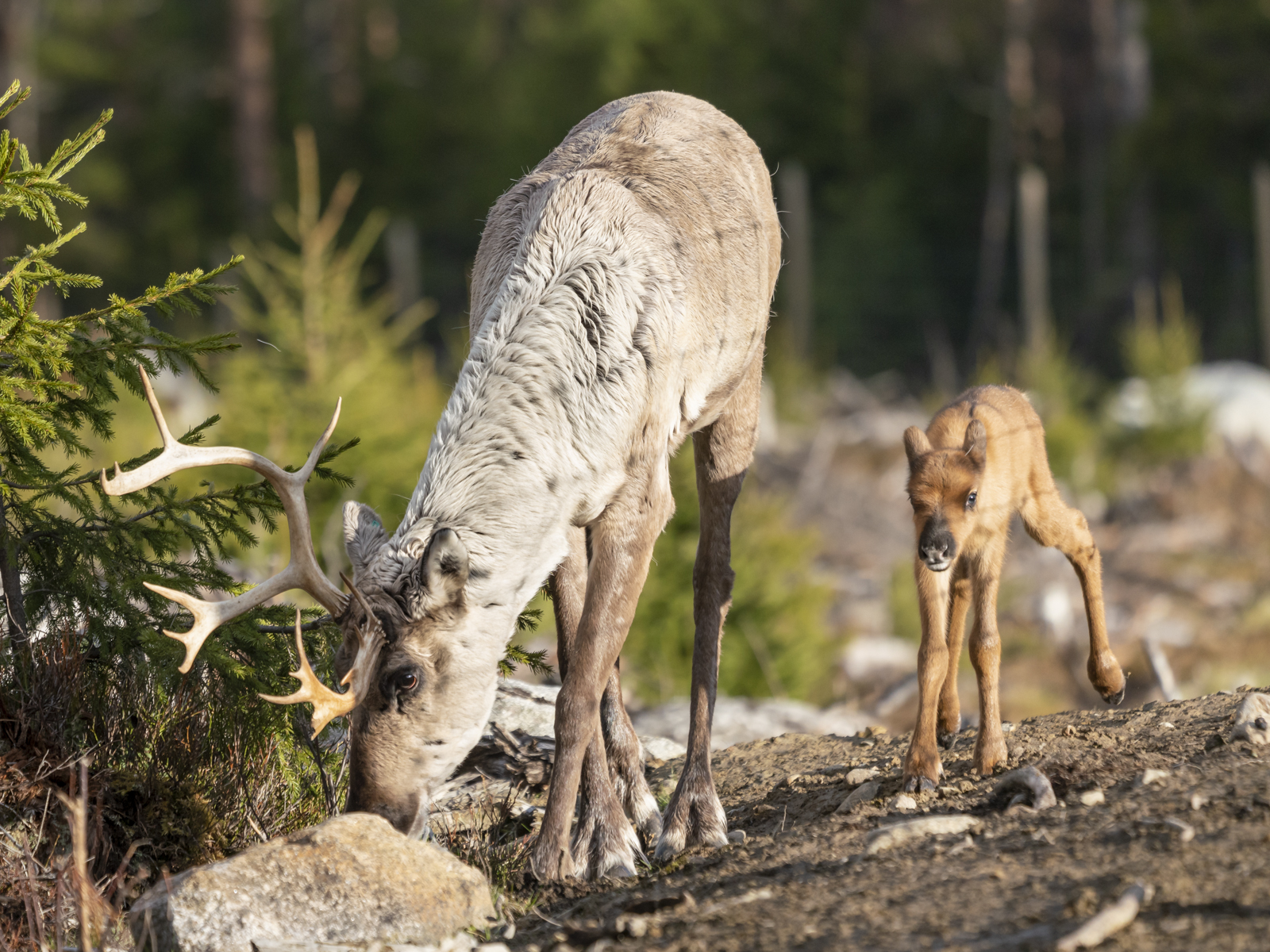
During the WildForestReindeerLIFE project (2016–2023), the WFR was reintroduced to its former range in South Ostrobothnia and Pirkanmaa. After a period in a breeding enclosure, 42 individuals were released into Lauhanvuori National Park and 40 into Seitseminen National Park. The Lauhanvuori subpopulation was further supported in 2025 by releasing five young males originally born in zoos after a short period in a breeding enclosure. In late winter 2026, a WFR population of a few dozen individuals occurs in the vicinity of both national parks. Both subpopulations reproduce naturally.
One of the key conservation measures in the LIFEline4Fennicus project is to support the Lauhanvuori and Seitseminen subpopulations through reinforcements. In the long term, the objective is that the subpopulations could not only unify with each other, but also establish a connection with the Suomenselkä subpopulation. The most effective way to accelerate unification is to support population growth and thereby enable natural dispersal into new areas. As Lauhanvuori and Seitseminen differ in their key characteristics, different strategies have been selected for supporting the subpopulations.
The Lauhanvuori National Park area and its surroundings include some of the best ground lichen pastures in Finland, and in particular the undrained mires provide excellent calving and calf nursing habitats. Due to abundant and easily accessible resources, individuals originally born in zoos or in a breeding enclosure tend to fare well after release. On the other hand, in the Lauhanvuori area there have been both direct and indirect signs of predation on WFR by large carnivores; three adult individuals have been confirmed to have been killed by wolves, and calf survival has been low. During the project, the Lauhanvuori subpopulation will be supported, in simple terms, by releasing as many individuals as efficiently as possible into the national park. This means, first, that a breeding herd will be maintained in the breeding enclosure for almost the entire project period, and second, that young individuals born in zoos will be transferred to the Lauhanvuori breeding enclosure unless they are needed for maintaining the zoo population of WFR.
Seitseminen National Park and the surrounding areas provide suitable habitats for WFR, particularly good summer habitats. However, the area’s lichen resources consist mainly of small rocky lichen patches, and winter food resources are therefore more patchily distributed than in Lauhanvuori. There are also some signs of predation by large carnivores in Seitseminen, but the area has not hosted a reproducing wolf pack. In reinforcing the Seitseminen subpopulation, emphasis will be placed on the quality of individuals rather than on numbers. The plan is to carry out two short periods in a breeding enclosure by capturing 3–5 adult females from the Suomenselkä subpopulation and releasing them after a few months in a breeding enclosure, potentially together with their calves born during the enclosure period. The calves, and the WFR already occurring in the area, are expected to help retain the females in the Seitseminen area. Females born in the wild have better chances of utilizing patchily distributed food resources compared to individuals originally born in zoos, and at the same time they will increase the genetic diversity of the local subpopulation.
The LIFEline4Fennicus project will also implement an entirely new reintroduction of WFR. The target area is Tiilikkajärvi National Park, located between the Suomenselkä and Kainuu subpopulations. The aim of the reintroduction is to accelerate the unification of these subpopulations. The unification of the Suomenselkä and Kainuu subpopulations is also one of the key objectives set out in the WFR conservation and management plan.
The reintroduction to Tiilikkajärvi National Park is planned to be implemented in 2028–2030. Before starting the reintroduction, a social impact assessment will be carried out in the area to determine whether there is local acceptance for the return of WFR. Without local acceptance, a reintroduction cannot succeed. The first part of the assessment will be carried out in 2027 and – if the reintroduction proceeds as planned – the second part in 2032.
Metsähallitus Parks & Wildlife Finland is responsible for the reinforcements and reintroduction, with Korkeasaari Zoo, Ranua Wildlife Park, and the Natural Resources Institute Finland (Luke) also contributing. The zoo partners play an important role not only in producing founder individuals for reinforcements, but also as experts in WFR feeding, husbandry and handling, and in developing these practices. Luke will participate in capturing founder individuals from the wild as well as in monitoring WFR released from the breeding enclosure.
Last updated 18 May 2026