Nature management in commercial forests is the most effective nature management
This text was published in the blog of Priodiversity LIFE. Check out the other blog posts as well (metsa.fi).
24.6.2025
Most of Finland’s forests are commercial forests. They play a key role in retaining biodiversity in forest ecosystems and offer several possibilities in adding biodiversity.
Why should nature be managed, doesn’t it get along on its own? Our forest nature has changed, and we have not been successful in preventing nature loss. We depend on natural resources, and a biodiverse nature creates opportunities for forest-based livelihoods. We humans also benefit from taking care of nature and our environment.
Nature management in commercial forests can enliven forest nature
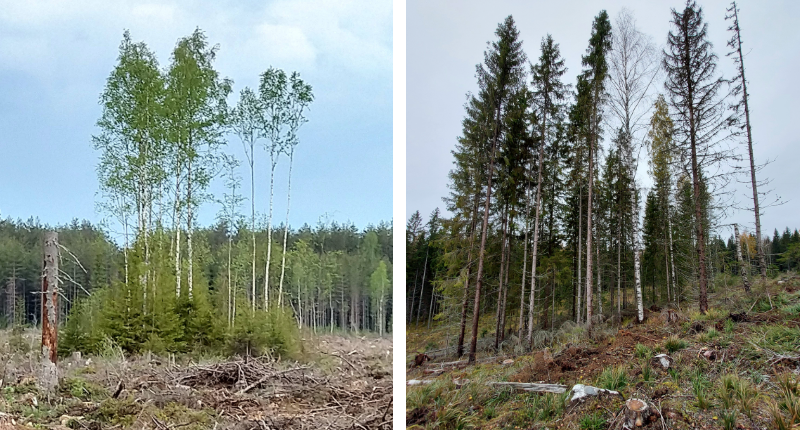
Biodiversity in commercial forests can be improved by methods of nature management. These tools include, for instance, leaving retention tree groups and wildlife-protecting bushes in the forest, favoring deciduous trees and mixed stands, as well as retaining decayed trees. Forested protection zones close to waters, as well as vegetated areas in the proximity of peatlands or agricultural lands are useful methods in nature management.
There are four native coniferous tree species in Finland, but the spectrum of deciduous trees is more diverse with 27 species. Even though coniferous tree species are fewer in numbers, their overpower in our forests is undisputed, as appr. 80 % of Finland’s forests are dominated by pine and spruce. Favoring broadleaved trees significantly increases the biodiversity of our forests, as every tree species hosts its own community of associated species.
Is nature management expensive?
Not necessarily. For instance, the placing of retention tree groups and wildlife-protecting bushes can affect economic consequences. The retention tree groups can be placed in areas with weak carrying capacity, as the costs of log harvesting in such locations can outgrow the wood sales revenue. Regeneration fellings have sometimes been criticized for ruining the landscape. Leaving retention tree groups close to the remaining standing crop and clear-cut area can mitigate the landscape nuisance.
Accommodating species with small economic value such as aspen, willows, rowan and alder in retention tree groups benefit the nature but have only small economic impacts. In addition, dead and decayed wood can be included in retention tree groups and shouldn’t be harvested from stands marked for harvesting.
One must admit that retention trees take growing sites from merchantable timber, and loss of income is caused by some logs depending on the size of the retention tree group. On the other hand, savings are created from a corresponding area, since regeneration costs are avoided.
Increasing the share of broadleaved trees in a stand and favoring mixed forests is minimizing the risk of forest damages and subsequent economic losses. It has been noted that mixed forests have better wood production rate than single-species forests, which may be rewarding for forest owners. Eventually, it might be even more expensive to not use methods of nature management than just introduce them and make acts for nature.
Weak communication can prevent successful nature management
Forest owners are interested in nature management in commercial multiple-use forests. One of the most significant factors hindering successful nature management is insufficient communication. It’s extremely important to make sure information reaches everyone working on a certain forest site, also in situations where operators change for one reason or another. This is why we encourage people to make a written agreement about the forest owner’s wishes.
Additionally, it’s possible that service operators cannot support the cultivation of mixed forests when regenerating a forest. Should the procedures be updated to better meet the current requirements when renewing forests?
Together we can improve the state of nature
In the project Priodiversity LIFE we strive together with different organizations to improve the state of nature. One of our goals is to increase the nature management skills of forest professionals, forest owners and influencers. We offer possibilities for forest owners to execute nature management in their forests, and free counselling in introducing methods of nature management in commercial multiple-use forests.
With more information, thoughts and plans can become acts.
Heidi Oranen, Nature management specialist, Finnish Forest Centre
Priodiversity LIFE offers solutions to halt nature loss. The project gathers a wide range of committed operators who together have the chance to find the most impactful and cost-efficient ways to stop nature loss in Finland. In the project we will create requirements to make halting the nature loss into a new skill for Finnish entrepreneurs, and to make Finland an expert on international scale. Priodiversity LIFE is coordinated by Metsähallitus Parks and Wildlife Finland.
Priodiversity LIFE – for halting biodiversity loss (metsa.fi)
