More Finnish fish
Fish consumption has increased in Finland, while the share of domestically produced fish has declined. Many consumers would like to buy more Finnish fish. To help increase its availability, Metsähallitus identifies potential fish farming sites in the state-owned public water areas under its management.
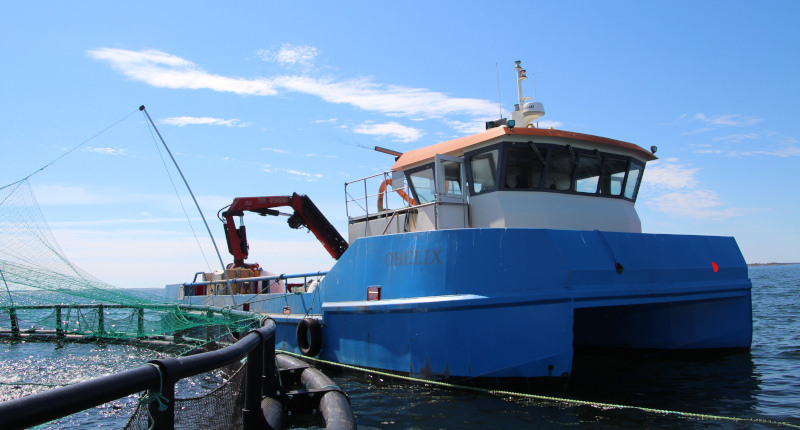
Fish farming in public water areas
Metsähallitus manages more than two million hectares of public sea areas. Companies may apply to Metsähallitus for the right to use suitable public water areas for fish farming.
Coastal waters and waters within village boundaries are generally privately owned. State-owned public water areas lie outside these areas, while Finland’s exclusive economic zone extends beyond the public water areas.
The identification of potential fish farming sites focuses on the public sea areas managed by Metsähallitus. Protected areas and areas reserved for other specific state purposes are excluded from consideration.
How to apply for the right to use a water area
Before applying for an environmental permit, the operator must have the right to use the proposed water area. Applications concerning public water areas are submitted to Metsähallitus.
We assess applications against the national spatial planning framework for aquaculture. We also carry out a preliminary internal assessment that considers other activities and interests in the area, including nature conservation and offshore wind power. Internal guidance confirms that potential fish farming sites are assessed in relation to water and marine management objectives and the national spatial plan for marine aquaculture.
If no operational obstacles are identified and the operator commits to complying with our operating principles, we may conclude a preliminary agreement. The agreement is confirmed once the operator has obtained the required environmental permit.
The fee for the right of use consists of a basic fee and a component linked to the volume of fish produced. The fee is paid to Metsähallitus annually.
Environmental permits and supervision
Fish farming requires an environmental permit when at least 2,000 kilograms of dry feed, or an equivalent quantity of other feed, is used annually, or when the annual increase in fish biomass is at least 2,000 kilograms. Depending on the project, a permit under the Water Act may also be required for structures, water intake or other measures affecting the water area.
The permit can be granted only if the operation does not cause harm to human health, significant environmental pollution or a risk of such pollution.
Environmental permits are applied for from the Finnish Supervisory Agency. Operators must report annually on the matters specified in their environmental permits. Environmental supervision is based, among other things, on annual reports and reports on emissions and environmental effects.
Marine spatial planning and site selection
Aquaculture is one of the activities considered in Finland’s marine spatial planning process. When identifying potential fish farming sites, account is taken of environmental values, nature conservation areas, shipping, fisheries, offshore wind power, recreation and other existing uses of sea areas.
Marine spatial planning does not grant permits or allocate areas to operators. Instead, it provides information that supports planning, site selection and the coordination of different activities in marine areas.
Selecting suitable locations
The potential environmental effects of fish farming depend greatly on the location and conditions of the site. The national spatial planning framework guides marine fish farming towards areas whose physical, chemical and ecological conditions are suitable for the activity.
The assessment considers factors such as:
- water depth and openness
- water currents
- ecological status
- potential nutrient effects
- protected areas and nature values
- other uses of the water area
- water and marine management objectives
Location data and modelling can be used to assess the potential effects of fish farming on water quality and ecological status. The location assessment also seeks to ensure that fish farming does not compromise the achievement of water and marine management objectives.
Further information on site selection methods used in Finnish aquaculture is available from the Natural Resources Institute Finland (Luke), including the FINFARMGIS spatial planning tool for assessing suitable fish farming locations.
- The FINFARMGIS method helps to assess the location of a fish farm (Luke.fi)
- Fish and aquaculture research and services (Luke.fi)
Developing aquaculture through cooperation
Metsähallitus works with public authorities, research institutes, companies and other stakeholders to develop practices for identifying and assessing potential fish farming sites.
In the Kalavaltio project, Metsähallitus, the Natural Resources Institute Finland and the Finnish Environment Institute have examined the suitability of state-owned public water areas for fish farming and developed spatial planning methods for aquaculture.
The assessment of potential sites takes environmental, social and economic factors into consideration. The project also uses spatial data, modelling and other assessment methods to examine the suitability of sea areas for fish farming.
Contact details
Ida Montell
Puh. +358405122480